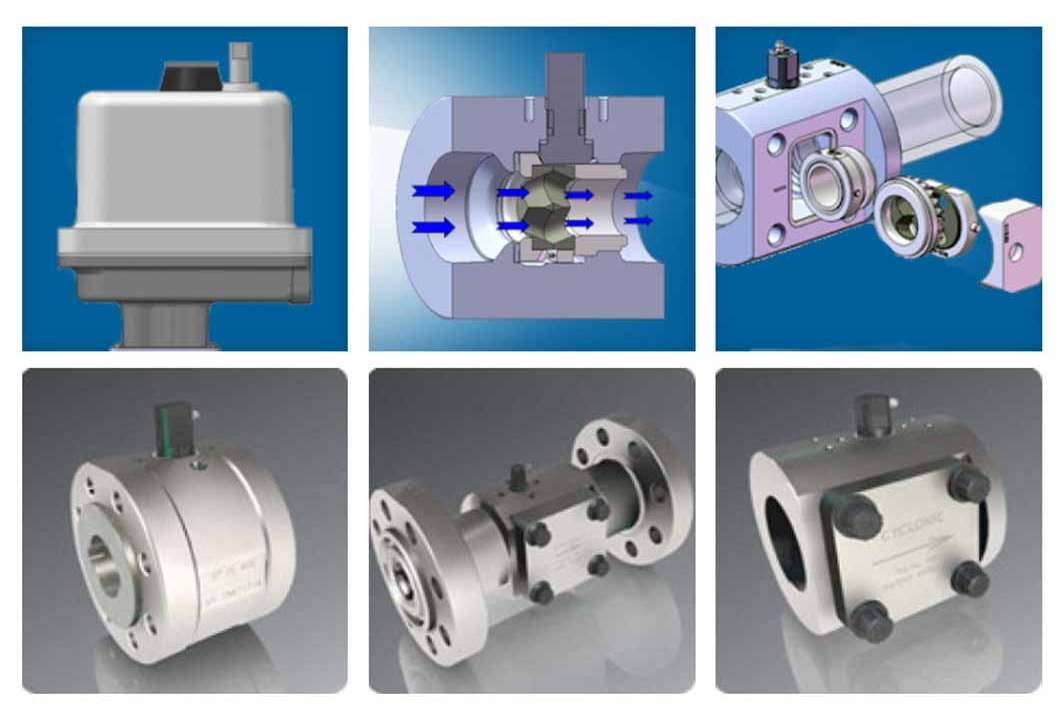
Cyclonic Choke Valves
Technologically Advanced. Superior Design.
Easily automated, lower torques, and multiple body types.

CYCLONIC VALVE vs THE COMPETITION
Cyclonic Valve
- American made
- Higher quality standard materials
- Valves are made of solid CS or SS bar stock material
- No casting issues
- No porosity from bad castings
- Limitless overall length possibilities
- Better design
- Straight, flow-through path as opposed to angular (more turbulant) bodies
- Minimizes pressure drop, erosion, and cavitation
- Internal gear drive - 3:1 or 2:1 turndown ratio provides finer, more responsive disc control and sustainability, and reduced torque
- Lower torque + smaller actuator requirements = cost savings
- Simple automation unlike traditional needle and seat, in-line, or top entry chokes styles
- Side entry design allows easy in-line replacement of discs and change orifice sizes to accommodate flow changes
- Also allows for complete inspection and maintenance
- Field lubrication through stem grease fitting
- 100% testing per ANSI B16.34/API 598 standards
- Tungsten carbide discs and wear sleeve allow extended downstream erosion protection
- Pressure ratings to 10,000 PSI MOP
- Sizes available from 1" through 6"
- End connections available in API and ANSI flanges, FNPT, BW, SW, Victaulic, wafer style, or other specified connections since the valves are machined from bar stock
The Competition
- Traditional in-line chokes
- Cast stainless or aluminum bronze bodies are prone to poor castings, longer lead times, and higher porosity and potential leaks
- With handles rotating across the body, these are more difficult to automate and typically require a mounting plate mounted to the body, thread-all, and turn buckles to create the linkage to the actuator
- Top entry chokes
- Angle body and mounting pad allow for direct mount of actuator but increases risk of coupling drift on the valve causing side-loading on the stem and increased torque which can stall the actuator
- Even with stellite or tungsten carbide downstream wear sleeves, the angular geometry of the body casting opens the bodies up to pinhole leakage on the bottom of the valve due to the erosive, jetting flow
- 90 degree rotation doesn't offer the precision adjustment of Cyclonic's 180° and 270° rotation
Cyclonic Applications
- Gas Control and Plunger Lift
- Production Chokes
- Automated and Manual
- Control of High Pressure Injection of CO2, Water, and Steam
- Saltwater Disposal Systems
- H-Pump Back Pressure Control
- Bypass Valves
- Blow-off and Bleed-down Valves
- OEM Downhole and Horizontal Pump Testing Facilities
- Compressor Suction, By-pass, and Discharge Valves